More than a day of buying and selling
A rural fair could bring people together to trade animals, hire workers, meet neighbours, enjoy entertainment or settle business. A market might serve a more regular need for food and other goods. Their purposes varied by place and period, and the distinction between a fair and a market was not always neat. Both could make a small settlement feel, for a day, like the centre of a much wider area.
Much of that activity was temporary. Stalls came down, livestock moved on and visitors returned home. This makes rural fairs and markets an absorbing subject for local heritage: their importance may be clear even where little of the event itself remains. To understand what survives, it helps to look beyond a single building or object and ask how people used the surrounding streets, routes and open spaces.
Reading the landscape
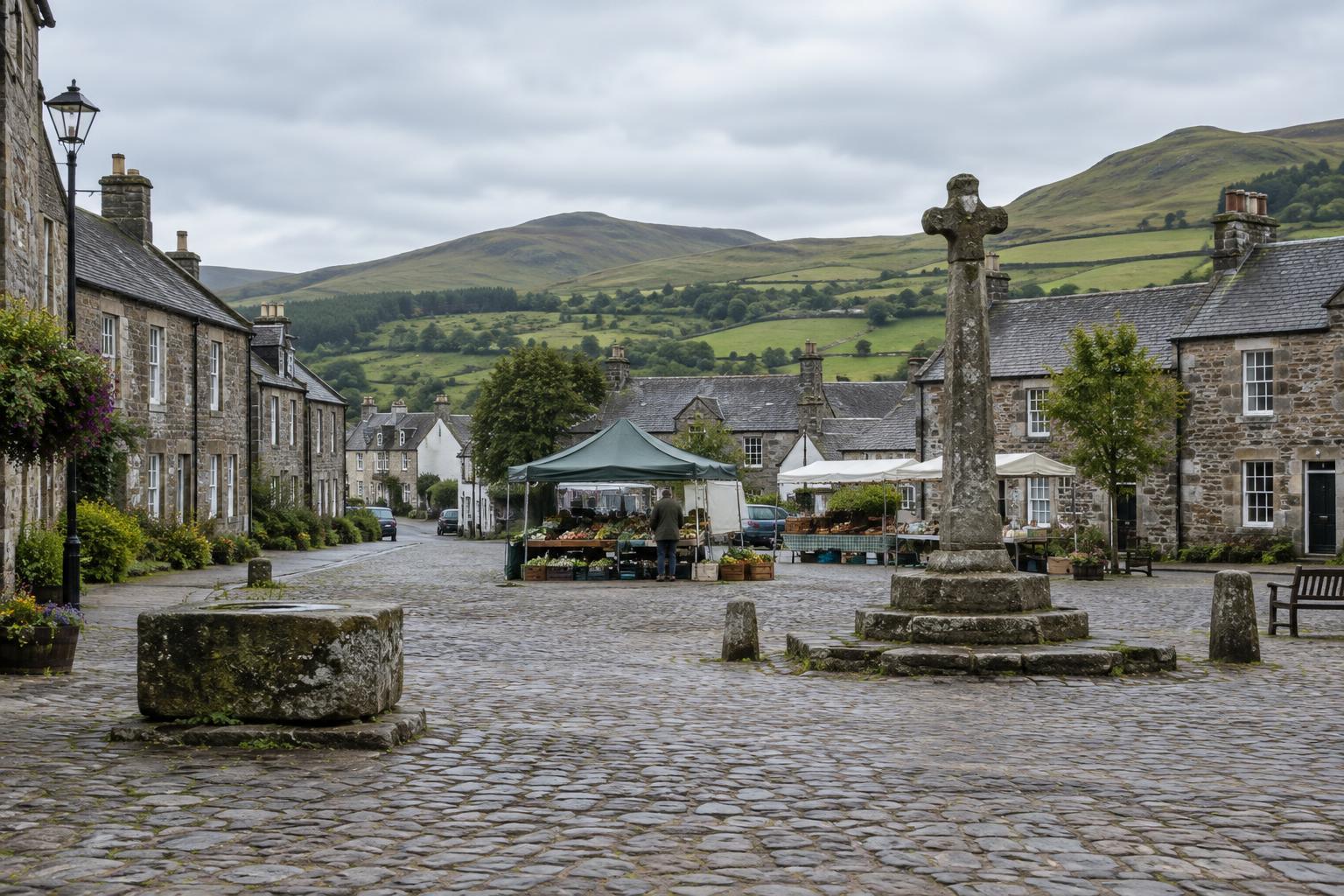
A broad street, open square or field near a settlement may invite questions about past trading. So might an old route connecting farms with a village. Place names containing words such as “market” or “fair” can offer further clues. None of these features proves, on its own, exactly what happened there. Streets change shape, open ground acquires new uses and names can outlast the activities that inspired them.
A useful local investigation starts by comparing clues. An older map may show an open space that is now built over; a later photograph may show its new use. Walking the site can reveal how it connects to roads, inns, bridges or former meeting places. Together, these observations help explain why a location may have suited a gathering. They also remind us that the landscape visible today is one layer in a longer story, not a preserved scene from the past.
Objects, records and what they cannot tell us
Local collections may hold tools, weighing equipment, signs, photographs or printed notices associated with trade and public gatherings. Written records can provide dates, rules, payments or references to goods and animals. Such material can establish that an event took place and sometimes show how it was organised. It rarely captures every person who attended or the full experience of a crowded day.
The gaps matter. A notice might describe an official arrangement but say little about informal exchanges nearby. A photograph records one moment from one viewpoint, perhaps chosen because it looked especially lively. Even a well-documented fair may leave quieter participants hard to see. Reading an object label, a map and a photograph alongside one another is often more revealing than asking any single item to stand for the whole event.
Memory and changing traditions
For some communities, a fair or market survives as a recurring event. Elsewhere, it may live mainly in family stories, remembered routes or accounts collected by local history groups. These forms of heritage can illuminate details that formal records overlook: the preparations before a gathering, the journey into town or the social importance of seeing familiar faces. A present-day event, however, should not automatically be treated as an unchanged continuation of an older one.
Memories deserve care as well as attention. People may recall different names, locations or purposes for the same gathering, and recollections can bring several periods together. Rather than forcing them into one tidy account, a heritage project can identify who remembers what and compare those accounts with surviving records. Differences are not necessarily obstacles; they can show how the meaning of a fair changed across generations.
Showing the past without recreating certainty
Film and visual storytelling can make these scattered traces easier to explore. A camera can follow an approach road, pause at a former gathering space and move between a present-day view and a clearly identified historic image. An interview may explain what a market meant to one family, while a map helps viewers place that experience within a wider district. Simple captions can distinguish a documented fact from a possibility or a personal recollection.
The strongest account does not need to pretend that every stall, sound or conversation can be recovered. It can show what remains, explain what has changed and leave room for what is unknown. For visitors, residents and filmmakers alike, Scotland’s rural fairs and markets offer a way to read local places as networks of work and social life. Their heritage survives not in one complete snapshot, but in the connections we can carefully make between landscape, collections and memory.