Not a modern parliament in medieval dress
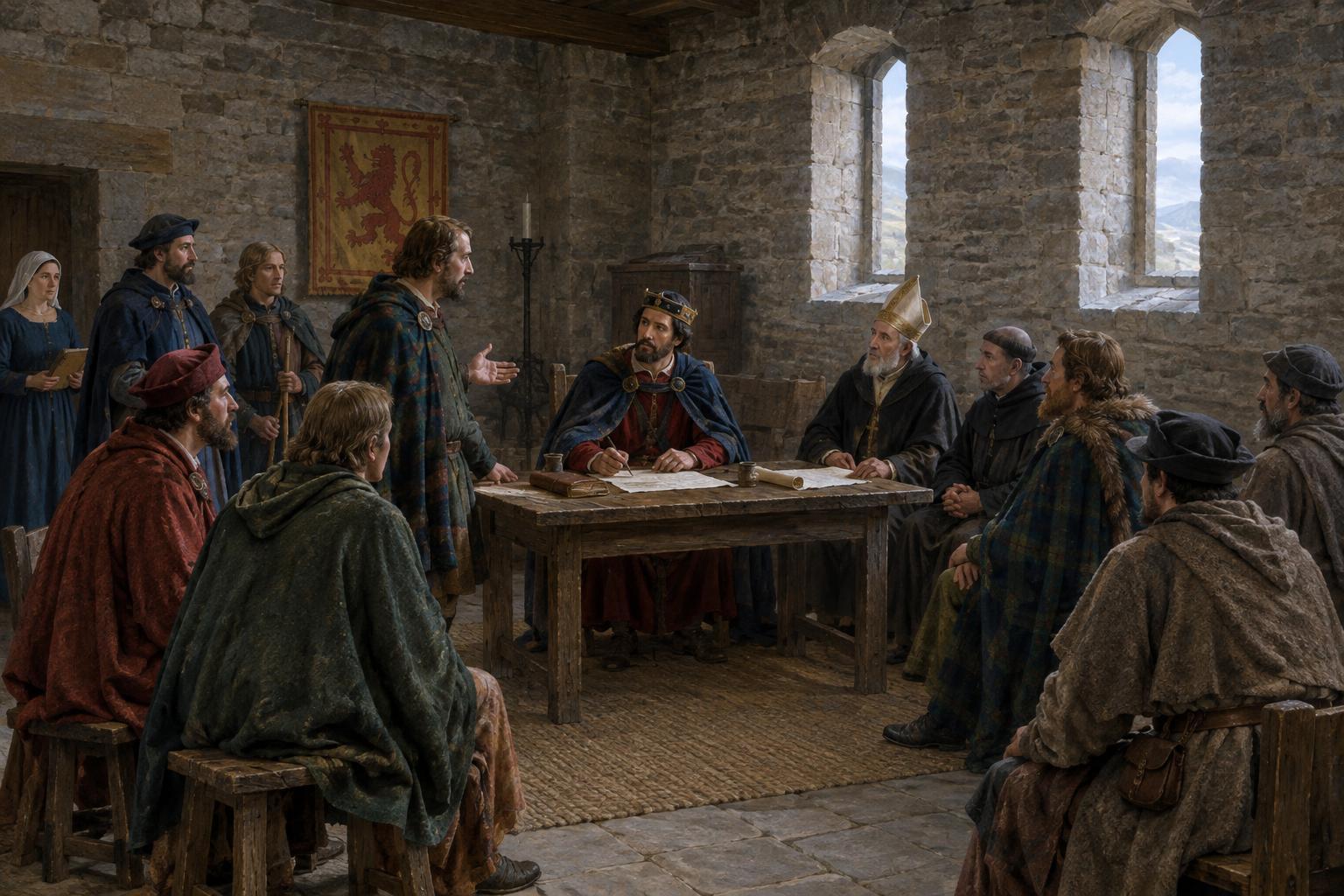
The word “parliament” can bring to mind elected representatives, party debates and a government facing an opposition. Those expectations do not fit medieval Scotland. Parliament was an assembly called by the monarch, bringing together people whose position gave them a recognised role in the kingdom’s affairs. Its membership and procedures developed over centuries, and it did not meet on a fixed modern schedule.
Scottish parliaments emerged in the thirteenth century from earlier royal councils and assemblies. By the later Middle Ages, parliament was commonly described in terms of three estates: the clergy, the nobility and representatives of the royal burghs. These were not three equal groups representing everyone in Scotland. Many people had no direct voice, and attendance could vary. To understand what parliament did, it helps to think of it as one important setting for government rather than the sole place where decisions were made.
Making laws for the kingdom
One of parliament’s clearest jobs was to approve statutes: rules intended to apply across the kingdom. These could address matters such as justice, trade, public order and the responsibilities of local officials. A statute set out an intention, however, rather than guaranteeing that everyone would obey it. Putting a law into practice depended on royal officers, local courts and other authorities, whose reach differed from place to place.
Parliament also offered a way to give a decision public weight. The monarch remained central to the process, but bringing influential estates into an assembly could help establish that a measure had wider assent. Surviving records tell us a great deal about the decisions recorded as acts. They tell us less about every conversation, disagreement or compromise that led to those decisions.
Agreeing to taxes and dealing with the crown’s needs
Medieval rulers needed resources for purposes that might include defence, royal administration or other major demands on the kingdom. Parliament had a significant role in consenting to certain taxes. That did not mean it controlled a comprehensive national budget in the modern sense. The crown drew income from several sources, while collecting an agreed tax required further work beyond the assembly itself.
Consent mattered because an extraordinary demand could affect powerful landholders, church institutions and towns. Parliament gave them a place to hear what was proposed and take part in a formal decision. It was therefore useful to the monarch as well as to those asked to contribute. The relationship was not simply one of parliament restraining a king: rulers could seek support through it, while participants could use it to press concerns of their own.
A forum for justice and difficult political questions
Parliament’s work was not confined to lawmaking and taxation. It could deal with serious legal and political matters, including disputes involving prominent people and decisions about forfeiture, in which a person could lose lands or rights. Such business reminds us that medieval government did not separate legislative, judicial and political functions as neatly as we often do today.
Assemblies could also become especially important when the normal exercise of royal authority was uncertain—for example, during a minority, when a monarch was too young to rule independently. Yet parliament was not the only forum available. Royal councils and other assemblies also handled public business, sometimes with overlapping participants. Looking only at parliamentary acts would give an incomplete picture of how Scotland was governed.
How to picture a parliament—and its limits
A useful image is not a permanent debating chamber full of elected politicians, but a gathering convened for particular business. Proposals had to be prepared, participants had interests to defend, and an agreed act still had to be communicated and enforced. In the later medieval period, smaller groups could help prepare parliamentary business; the ways this happened changed over time.
Medieval parliament was influential, but its influence was neither constant nor unlimited. It could give laws authority, provide consent to taxation and make consequential judgments. It also reflected a society in which status and access to the monarch shaped who could participate. Keeping both points in view avoids two misleading pictures: a powerless ceremony on one hand, and an early version of modern representative democracy on the other.