Begin with the medieval town
St Andrews is easy to approach as a collection of famous sights, but it is more rewarding to treat its streets as part of the story. The town’s medieval religious institutions drew students, clergy, pilgrims and visitors into a small area beside the sea. A walk between the cathedral precinct, the university’s historic buildings, the castle and Holy Trinity Church makes those connections easier to see.
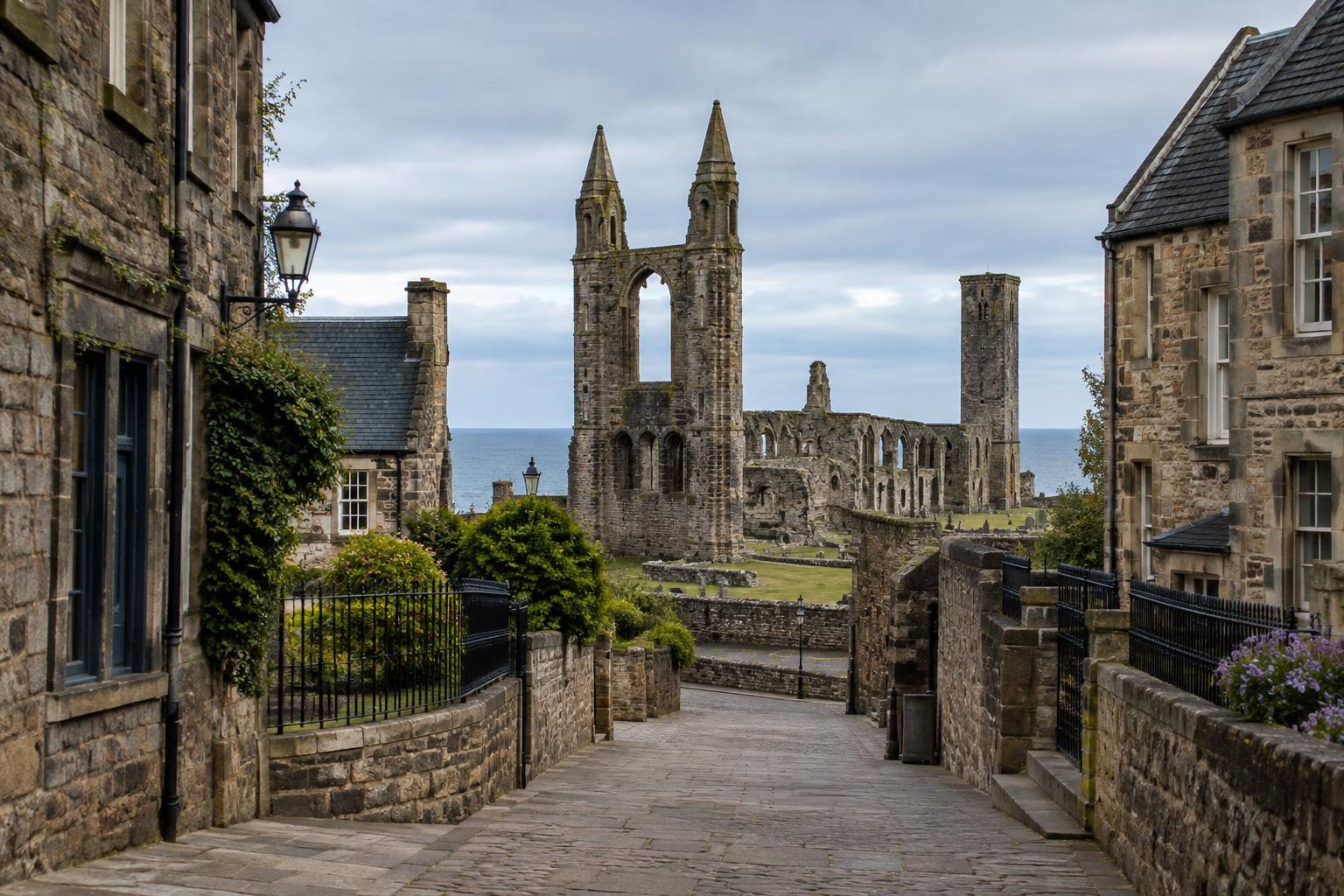
Start at the cathedral ruins near the eastern end of town. The scale of the remaining walls suggests the importance of the church that once stood here, while the open ground makes clear how much has disappeared. St Andrews Cathedral was a major centre of medieval religious life, not simply a picturesque ruin. Look, too, for St Rule’s Tower, which belongs to an earlier phase of the site. Rather than imagining every surviving stone as part of one finished building, notice the layers: successive structures, changing uses and centuries of loss.
Follow the university through the streets
The University of St Andrews took shape in the early fifteenth century and received papal recognition in 1413. Its origins make sense in a town with strong ecclesiastical connections: medieval higher learning and religious life were closely linked. That relationship did not mean the university remained unchanged. Its colleges, subjects and practices developed as Scotland’s religious and intellectual world changed.
Walk west along North Street towards St Salvator’s Chapel and its neighbouring college buildings. This is a working university, so the surroundings are not a preserved medieval set. Students and staff still move through spaces shaped by a long institutional history. Continue towards South Street and St Mary’s College, another place to consider how a university can carry older architecture and traditions into a different era. Check access information before visiting interiors; even when buildings are closed, their positions in the town help explain how learning became woven into everyday St Andrews.
Read the Reformation at the castle and church
St Andrews Castle brings a more turbulent part of that history into view. It served as an episcopal residence and became a focus of conflict during the Scottish Reformation. The execution of Protestant preacher George Wishart in 1546 and the killing of Cardinal David Beaton later that year are bound to the castle’s story. Its surviving defences, including the famous mine and countermine, speak to the siege that followed. They are physical evidence of conflict, but they cannot, on their own, explain the beliefs and political interests of everyone involved.
Holy Trinity Church adds the perspective of a parish community. John Knox preached there in 1559, during a period of rapid religious upheaval. Visiting the church after the castle helps shift the focus from dramatic confrontations to the wider question of how worship changed. The Reformation affected images, furnishings, institutions and daily practice, but its effects unfolded over time. Likewise, the cathedral did not become the ruin visible today in a single moment. A careful visit leaves room for later neglect, reuse and weathering as well as religious change.
Make space for what the buildings cannot tell you
A useful route need not be long. Allow time to pause at each site, read available interpretation and look back along the streets connecting them. From the cathedral precinct, the short distances to the castle, university buildings and parish church make the town’s overlapping roles unusually apparent. If you plan to enter a managed historic site or university building, check its current opening and access arrangements before setting out.
The walk also offers a lesson in interpreting historical places. A chapel may preserve a medieval setting while serving a present-day community; a ruin may evoke an event without showing exactly how it happened. Photographs can capture these contrasts especially well: a university doorway in use, the castle against the shoreline, or open sky within the cathedral walls. Pair those images with clear captions distinguishing what is visible from what is known through historical accounts. St Andrews is most compelling when its landmarks are treated not as illustrations of one simple story, but as places where learning, faith and change met.