Begin with the shape of the town
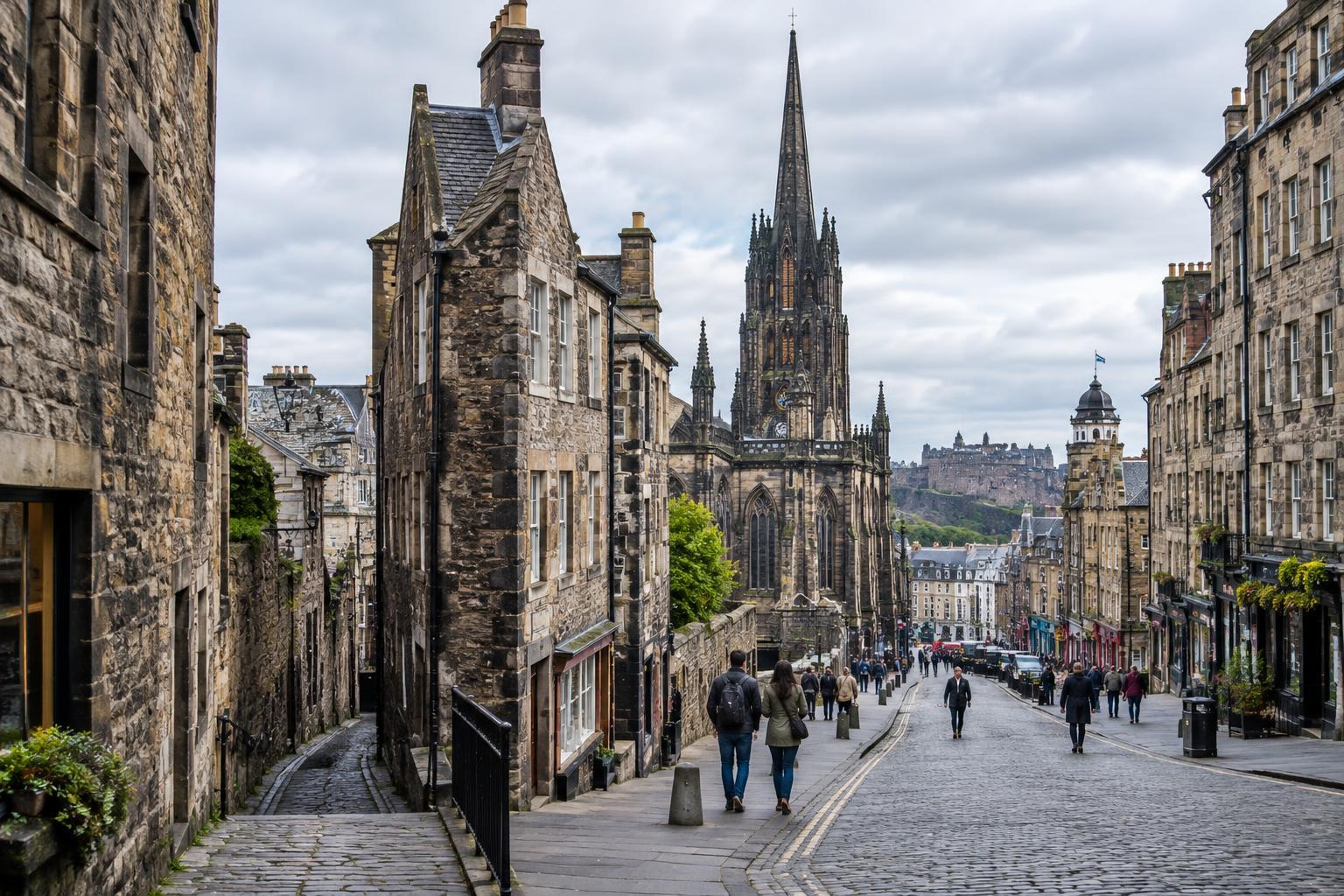
Start on the Castle Esplanade and look east before joining the Royal Mile. The route follows a ridge that descends towards the Palace of Holyroodhouse. That shape helps explain the Old Town’s distinctive plan: a long main street with narrow lanes, or closes, running away from it on either side. You do not need to enter every close to see how strongly the slope and limited space influenced the town.
Walk down Castlehill towards the Lawnmarket, pausing where you can safely stand clear of other pedestrians. Try looking past shopfronts and signs to the widths of passages and the heights of buildings. Some routes preserve aspects of an older street pattern, but the buildings around them have been altered, rebuilt and put to new uses. The most useful question is not “Is this medieval?” but “Which parts of the place suggest continuity, and which show change?”
Take a close look at the closes
Around the Lawnmarket and High Street, choose one or two publicly accessible closes to explore rather than treating them as a checklist. Lady Stair’s Close leads towards the courtyard of the Writers’ Museum and offers a good chance to notice how quickly the noise and scale of the main street can change. Return to the Royal Mile and compare it with another open passage nearby: one may feel like a short entrance to a courtyard, while another reveals a sharp drop in ground level.
These passages were working parts of the town, not simply picturesque shortcuts. They connected homes, businesses and shared spaces to the main street. Today, some also serve private residences or have restricted access. Respect gates and signs, avoid blocking doorways, and remember that a quiet close can carry sound into people’s homes. Comfortable shoes help on uneven paving and steps, especially in wet weather.
Read the civic centre at St Giles
Continue to St Giles’ Cathedral on the High Street. Its prominent position makes this a useful place to consider how religious and civic life occupied the same crowded centre. The building has a long history of change, so its present appearance should not be treated as a single glimpse of the medieval town. From outside, look at how it sits among open space, street traffic and surrounding buildings rather than viewing it as an isolated monument.
Walk around Parliament Square, beside St Giles, to bring another layer of civic history into view. The nearby Parliament House is associated with Scotland’s former Parliament and is now part of the courts. That change of use is a reminder that landmarks can keep a public role while their purpose changes. If you are photographing the area, make one wide image that shows the relationships between buildings, then a closer image of a doorway, paving line or change in level. Together, they tell more than an architectural detail alone.
Follow the Royal Mile into the Canongate
Keep walking east as the High Street gives way to the Canongate. The route remains recognisable, but the streetscape shifts. Notice the mix of older-looking frontages and later interventions without assuming that appearance reliably establishes age. Signs and plaques can offer useful starting points, though a short inscription rarely explains every phase of a site’s history.
The Canongate Tolbooth is a natural pause for thinking about local government and everyday administration. Farther along, Canongate Kirk and its churchyard offer a quieter setting; follow any access notices and treat the burial ground respectfully. From here, continue towards the foot of the Royal Mile, where the Palace of Holyroodhouse and the Scottish Parliament bring different kinds of public and political space into close proximity. Their presence makes a fitting end to a walk about a street that has never had just one function.
Make the walk your own
Allow time for detours and for retracing your steps. The walk is more rewarding when you stop to compare views than when you hurry from landmark to landmark. It also runs downhill from the Castle, though side passages can involve steep slopes or stairs. Check current access arrangements if you plan to enter a building, and use the main street if a close looks unsuitable for your mobility or the conditions underfoot.
For a simple visual record, choose one theme before setting out: changes in street width, views through closes, or the ways civic buildings meet the street. Take a few photographs from public spaces and note where you stood and what caught your attention. That small act of recording helps separate what you observed from what you inferred—a useful habit when exploring a place as layered, and as frequently pictured, as Edinburgh’s Old Town.