A long campaign, not a single turning point
The campaign for women’s parliamentary voting rights in Scotland stretched across generations. Its supporters worked in cities, towns and smaller communities, and they did not always agree on how change should happen. Some believed sustained persuasion would win over Parliament; others argued that disruption was necessary when petitions and speeches failed. Both approaches formed part of a wider campaign across Britain, but Scottish organisers shaped their work around local networks, meetings and opportunities for publicity.
The earliest suffrage societies emerged in the nineteenth century. Organisers gathered signatures, held public meetings and pressed politicians to recognise women as voters. The parliamentary franchise expanded for men during this period while women remained excluded. That contrast gave campaigners a clear argument: changes to the electorate should not continue to leave women out.
The organisations behind the movement
Local societies in Edinburgh and Glasgow helped build the early campaign. Later, Scottish supporters worked through branches and networks connected to the National Union of Women’s Suffrage Societies, or NUWSS. Often described as constitutional suffragists, its members used petitions, correspondence, public meetings and lobbying. Their aim was to demonstrate broad, durable support for a change in the law.
The Women’s Social and Political Union, or WSPU, also organised in Scotland. Its campaigners became known for militant tactics intended to force the issue into public view. The Women’s Freedom League, formed after a split from the WSPU, pursued its own programme of protest and nonviolent resistance. These names are useful guides, but they do not capture every participant. Women could support suffrage without belonging to a national organisation, and local campaigns depended on people willing to arrange venues, print material, raise money and speak to neighbours.
The movement crossed social boundaries, but participation was not equally easy for everyone. Time, money, employment and family responsibilities affected who could attend meetings or travel to demonstrations. A history focused only on prominent leaders risks overlooking the less visible work that kept organisations running.
Persuasion, protest and the cost of militancy
Constitutional campaigners sought to make suffrage familiar and persuasive. They organised talks, circulated literature and took part in public demonstrations. Such work could seem less dramatic than confrontation, but it required persistence: a petition had to be collected, a meeting advertised and an argument repeated to people who might be indifferent or hostile.
Militant campaigners used disruption to challenge that slow pace. Across the movement, tactics included interruptions at political events, acts of civil disobedience and, in some cases, damage to property. Arrest and imprisonment brought serious consequences for participants. Militancy also created disagreement among supporters of votes for women: some saw it as a response to political delay, while others feared it would turn potential allies away.
These differences should not be flattened into a simple story of two opposing camps. Tactics changed over time, and organisers were responding to the political choices available to them. Asking what a particular action was meant to achieve—and what risks it carried—offers a more useful way to understand it than treating every protest as either heroic or harmful.
What changed in 1918 and 1928
The First World War altered the setting in which suffrage campaigners worked. Many women took on wartime roles, while suffrage organisations made different choices about how to respond to the conflict. Women’s wartime contributions became part of the case for reform, but the vote was not simply a reward for war work. It followed decades of campaigning and wider debate about representation.
The Representation of the People Act 1918 gave parliamentary voting rights to some women over 30, subject to property-related qualifications. It was a major change, but it did not establish equal voting rights: many younger women remained excluded. The Equal Franchise Act 1928 removed that age difference, giving women the parliamentary vote on the same age terms as men, at 21. Keeping these two milestones distinct matters. Saying that women ‘won the vote’ in 1918 alone obscures the limits of that reform and the work that continued afterward.
Telling the story through surviving images
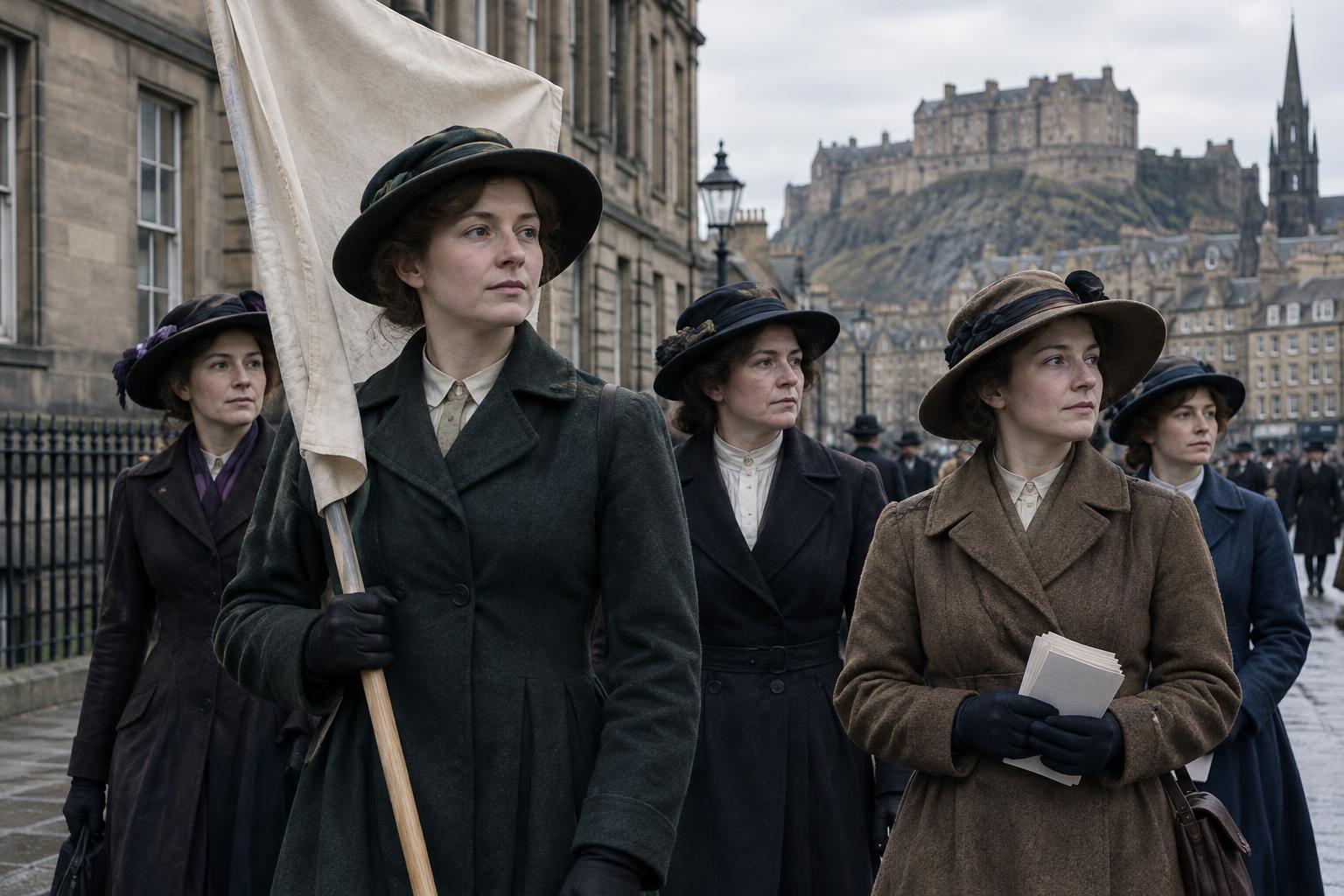
Photographs of processions, portraits of organisers, posters and newspaper illustrations can make the campaign feel immediate. They also show only part of it. A formal group portrait may identify leaders but leave out the people who prepared a meeting; an image of a crowded street cannot, by itself, tell us what everyone present believed. Visual storytelling works best when a caption explains what is known, distinguishes identification from inference and acknowledges what the image cannot prove.
Scottish suffrage history can also be explored through local places: meeting halls, streets used for demonstrations and communities where organisers built support. When interpreting such sites, it helps to connect a place to a documented event rather than assume that every surviving building witnessed a famous protest. The campaign’s lasting story lies not just in its best-known images, but in the sustained work that made political change possible.