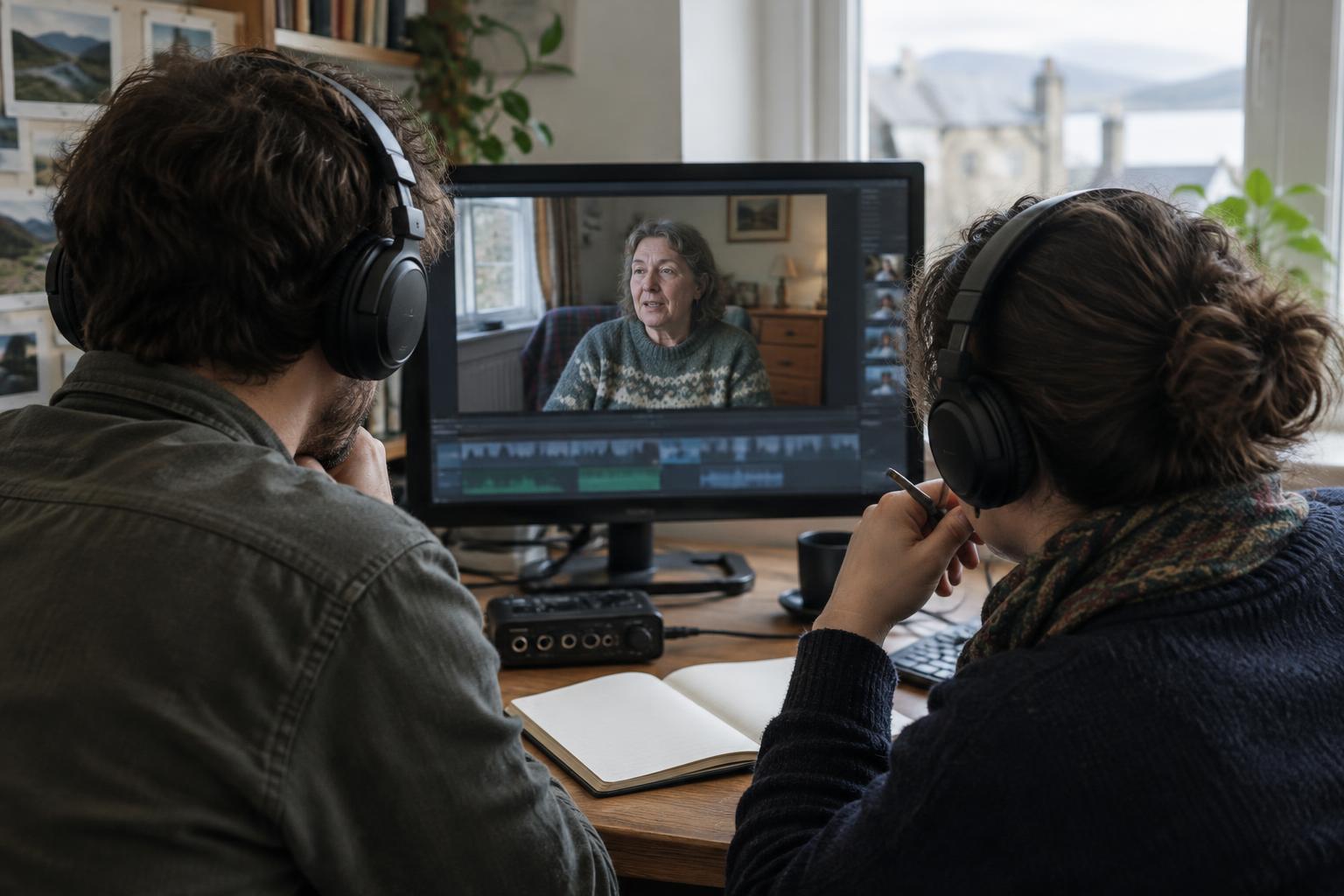
Begin with the voice, not the English subtitle
When an English-language documentary includes Scots or Scottish Gaelic, subtitles do more than help viewers follow a sentence. They influence how a speaker comes across: formal or familiar, hesitant or assured, humorous or solemn. The first task is therefore to establish what was said, rather than to draft an English line from what the editor thinks they heard. Keep the original recording, a time-coded transcript and the subtitle translation as separate materials so that each decision can be checked.
Scots and Gaelic call for different approaches. Gaelic is a language with its own grammar and vocabulary; translating it into English is not simply a matter of changing unfamiliar words. Scots also has its own vocabulary and structures, but its speech varies, and a passage may sit close to English in one moment and further from it in the next. Neither should be treated as a single, uniform voice. Note the variety and context where they matter to the film, without asking one speaker to stand for a whole community.
Decide what the viewer needs to read
A useful starting policy is to subtitle speech consistently when an English-speaking viewer needs help understanding it. Do not subtitle Scots only when it sounds unfamiliar to the production team, or leave a Gaelic phrase untranslated because it seems evocative. Those choices can make comprehension uneven and turn living speech into atmosphere. At the same time, a documentary need not force every audible word into a crowded caption. Subtitles should carry the meaning and tone needed for the scene.
Listen for names, place names, terms of address, jokes and changes of language. A speaker may switch between Scots, Gaelic and English for a reason: to quote someone, address a relative or choose a more precise word. An English subtitle may not be able to reproduce every shift, but the film can sometimes preserve it through the soundtrack, a brief on-screen indication or surrounding narration. Decide which distinctions are important before editing the speech into short lines.
Translate meaning without smoothing away character
A readable subtitle is not always a word-for-word translation. Spoken sentences trail off, repeat themselves and depend on gesture or shared knowledge. Condensing them can help viewers watch the image as well as read. The test is whether the shorter English line preserves the speaker’s point and attitude. If a joke, doubt or qualification disappears, the subtitle may be neat but misleading.
Avoid automatically replacing regional phrasing with polished standard English. That can make a speaker sound more distant or certain than they do in the recording. Equally, invented spellings or exaggerated colloquialisms in the English subtitle may impose a voice that was never there. When a term carries meaning that a short translation cannot hold, consider retaining it and supplying context elsewhere in the film. If the team disagrees over a phrase, record the alternatives and the reason for the final choice rather than hiding the uncertainty.
Build review into the edit
Subtitling benefits from more than one pair of ears. Where possible, ask speakers to check their own words and intended meaning, and involve someone with appropriate knowledge of the language or variety used. A fluent speaker can identify an error that an English-only editor would not notice; the person on camera can also explain a local reference. Neither review should be treated as a formality, particularly when a translation could change the apparent meaning of a personal memory.
Archive recordings need extra care. Age, noise, overlapping voices and incomplete documentation may make a word difficult to establish. Do not fill a gap with a plausible phrase and present it as a verified transcript. Mark uncertainty in working records, seek a further listening review, and use a restrained indication in the finished subtitle if the speech remains unclear. The same principle applies to a contemporary interview: clarity is valuable, but false certainty is not.
Check the subtitles as part of the film
Once the wording is settled, watch the documentary with the subtitles on. Check that each line appears long enough to read, follows the speaker closely and remains legible over changing images. Speaker labels may help when voices overlap or someone speaks off camera. Also check whether the edit leaves room for viewers to notice a face, landscape or archival image rather than asking them to read continuously.
Finally, distinguish translated dialogue from captions intended to describe sound. Viewers using captions may need cues for music, significant sound effects and speaker changes as well as words; a translation track alone may not provide that access. Keeping transcripts, translation choices and final subtitle files organised makes later corrections or alternate versions easier. Good subtitling does not erase the sound of Scots or Gaelic. It lets more viewers follow the film while the original voices remain central to it.