Build a route around four different abbeys
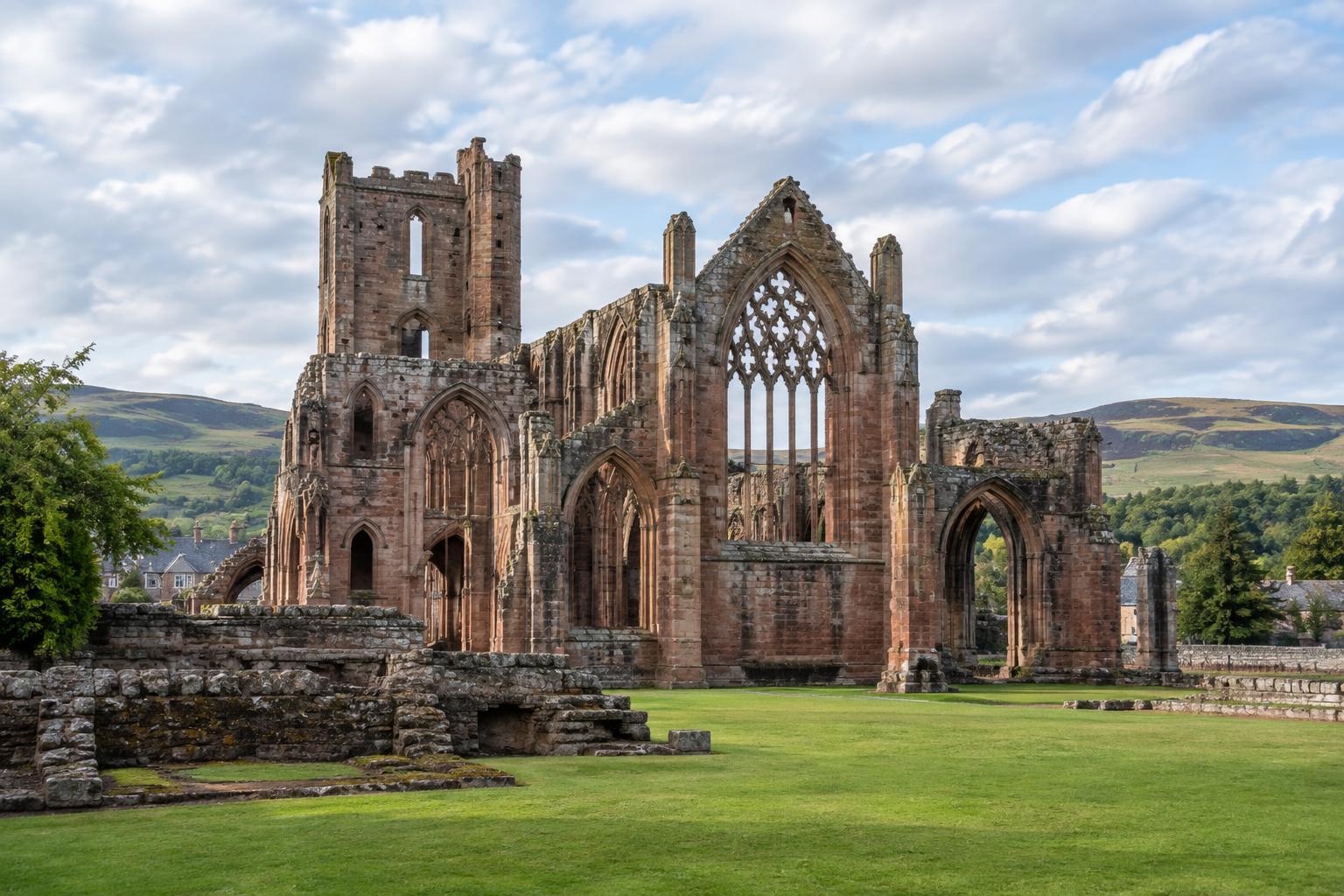
The medieval abbeys at Melrose, Dryburgh, Kelso and Jedburgh make a useful framework for exploring the Scottish Borders. They are close enough to connect on a short trip, yet different enough that visiting all four need not feel repetitive. Melrose rewards a close look at its surviving stonework; Dryburgh has a quieter, wooded setting near the River Tweed; Kelso’s remains sit within a working town; and Jedburgh’s tall ruins make a striking landmark.
Rather than treating the abbeys as stops to tick off, allow time for the places around them. A simple route might begin in Melrose, continue to Dryburgh and Kelso, then finish in Jedburgh. It also works in reverse. If you have only one day, choose two abbeys and enjoy the journey between them. With two or more days, you can slow down, walk through the towns and give each site its own place in the story.
Look for the history beyond the ruins
These abbeys were religious houses, but they were also part of wider networks of land, work and influence. Their scale can help visitors imagine how significant they once were to surrounding communities. As you walk, notice what survives and what does not: a high wall may suggest the shape of a church, while low foundations leave more to the imagination. An impressive ruin is not a complete picture of medieval life.
The Borders’ position between Scotland and England is important to the abbeys’ history, but conflict is not the only story worth telling. Monastic communities changed over time, and the buildings were altered, damaged and reused across centuries. Look for on-site interpretation that distinguishes between what can be seen, what is documented and what has been reconstructed. That habit makes the visit richer without asking the stones to answer every question.
Give each stop a different focus
At Melrose, make time to circle the abbey rather than viewing it from a single angle. Changes in light can bring out details in the carved stone and help you understand the building’s scale. Dryburgh invites a slower visit: its setting is part of the experience, and the surrounding paths can provide a sense of distance from nearby roads and towns. It is also associated with the burial of writer Walter Scott, a reminder that the abbey’s meaning continued to grow long after its monastic life ended.
Kelso calls for a different approach. Its surviving abbey fabric is more limited, so pair the stop with a walk through the town and along the nearby streets. At Jedburgh, step back to take in the height of the remaining structure before moving closer to study how its parts fit together. These contrasts are useful if you take photographs or make a travel film: wide views establish setting, while details reveal texture. Avoid presenting a dramatic shot as evidence for a historical claim it cannot support.
Plan for real travel conditions
Check current access arrangements through the organisations responsible for the sites before setting out. Opening times, conservation work and available areas can change, and a view of an abbey from outside is not the same as access to its interior. If a particular visit matters to you, leave enough flexibility to swap the order of your stops. A map can help you group nearby places, but do not assume that a short-looking journey leaves ample time to explore.
Weather and ground conditions matter too. Ruined sites often involve exposed spaces and uneven surfaces, so comfortable footwear and an extra layer are sensible choices. Visitors with mobility needs should check site-specific access information rather than assuming that all four abbeys will be alike. If you plan to use a tripod, record sound or fly a drone, check the relevant site rules and permissions in advance. Respect barriers and fragile stonework, even when a closer viewpoint looks tempting.
Leave room for the Borders between sites
An abbey trip is also a chance to notice how heritage sits within the present landscape. Stop for a meal, browse a local museum where one fits your route, or take a short walk that lets you see a town from beyond its central streets. River crossings, roads and settlement patterns can give useful context to the monuments, though the landscape you see today has changed since the abbeys were active.
If you keep notes or assemble photographs afterward, record where each image was made and which details came from interpretation at the site. That small step helps prevent one abbey’s features or stories from being assigned to another. The best itinerary does not need to cover every ruin at speed. It gives you enough time to see four distinct places—and to return with a clearer sense of both their shared history and their differences.