Start with the image’s identity
Before writing a credit, establish which image you have. Record its title or description, creator if known, approximate date if supplied, collection name and catalogue reference. A file named after a place is not enough: similar photographs may show the same street, building or event. Keep a copy of the catalogue entry or information supplied by the archive alongside your working file.
Be careful not to turn a tentative description into a fact. If a catalogue says “possibly Glasgow” or gives an approximate date, preserve that uncertainty in your caption. Likewise, distinguish what the image shows from what a later label claims it shows. This matters in historical storytelling, where an image can appear to confirm a narrative even when its location or subject has not been firmly identified.
Separate the credit from permission
A credit identifies and acknowledges an image; it does not, by itself, grant permission to use it. Check who holds rights in the image and what conditions apply to the copy you intend to publish. An archive may hold the physical print or digital scan without holding every relevant right. Its catalogue may state usage terms, or a staff member may need to clarify them. Do not assume that an image found online is free to reuse.
Ask about the uses you have planned: a film, its trailer, festival screenings, a website article and social media posts may not all be covered by the same permission. Note any required credit wording, licence notice, restrictions on cropping or alterations, and whether approval of the final use is requested. If the position remains unclear, choose an image with clearer terms rather than treating uncertainty as permission. This is a practical publishing check, not a substitute for legal advice.
Build a clear, useful credit
A good working template is: image title or short description; creator, if known; date, if known; collection or holding institution; catalogue reference; and the credit or licence wording required for your use. The elements need not appear in that exact order. Follow an archive’s specified wording when it has one, while keeping your own identification notes separately if the required line leaves out useful details.
Avoid inventing a photographer to fill a gap. “Photographer unknown” is more honest than assigning an image to a collector, publisher or archive that did not create it. For a family photograph, ask how the lender wants to be named and whether people pictured should be identified. If an image has been colourised, heavily cropped or otherwise changed in a way that could affect interpretation, say so near the image rather than hiding that information in production records.
Adapt the credit to the format
In an online article, place an identification caption close to the image so readers can connect the words to what they see. Include any required rights or licence notice there or in a clearly linked image-credit area. Where a licence asks for a link, make it usable in the published page. Descriptive alternative text has a different job: it helps someone understand the image, and should not be treated as the only place to put attribution.
In a film, end credits can carry fuller collection details and catalogue references, while a brief on-screen caption may be appropriate when the image first appears. Make credits legible for long enough to read, and check how they appear in smaller or shortened versions of the film. If several images come from one collection, a single general thanks may be tempting, but it can make individual images hard to trace. Keep an image-by-image list even if the final screen credit is condensed.
Keep a record you can return to
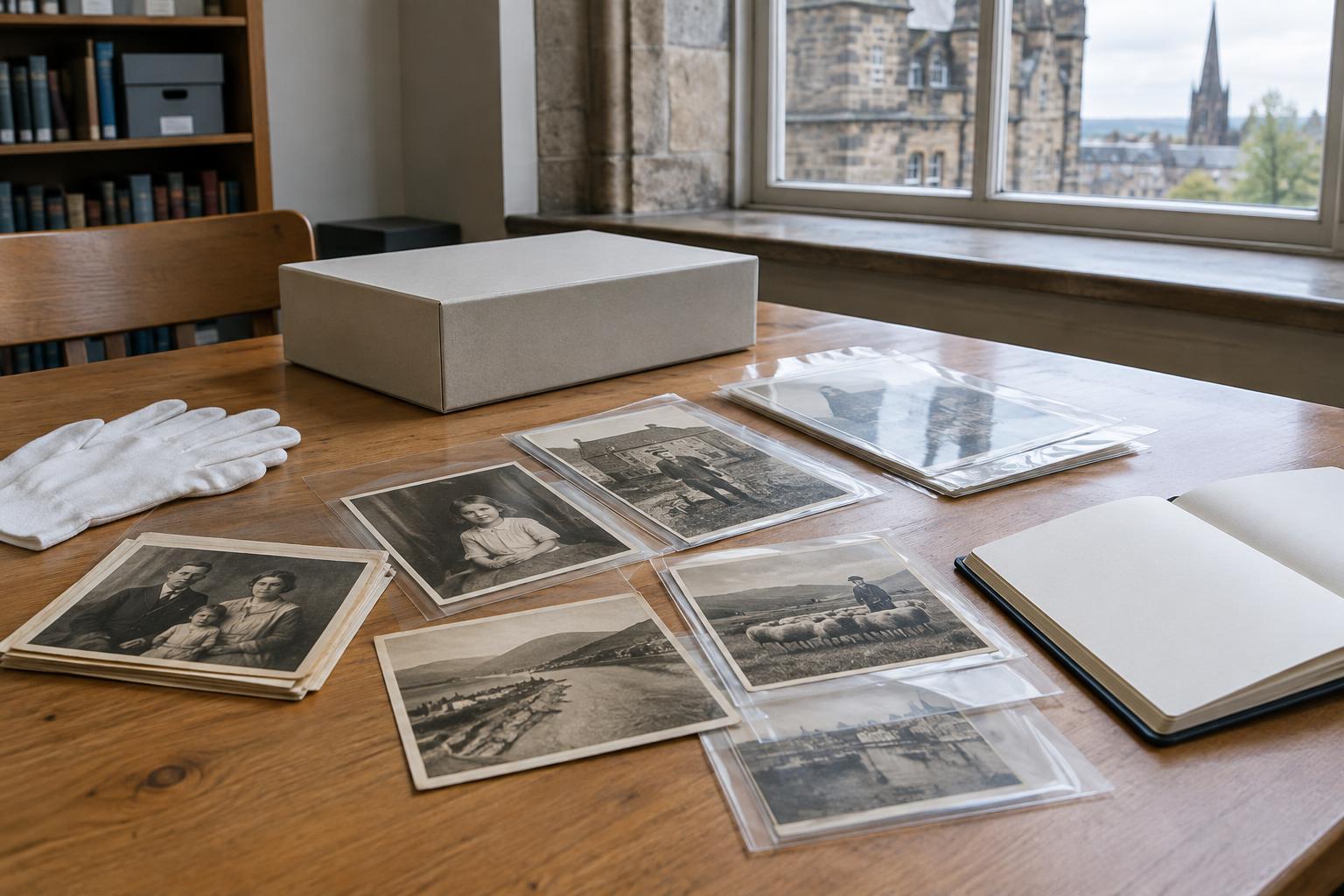
Create a simple image log with a thumbnail, source details, catalogue reference, rights contact, permission terms, approved credit wording and every place the image is used. Save relevant correspondence and note which version of the image was supplied. This makes it easier to answer a question from an archive, correct a caption or prepare a later cut of a documentary without reconstructing decisions from memory.
Give the published version one final check against that log. Confirm that each image has the right credit, that a caption has not become more certain than its source, and that any crop or edit remains within the agreed terms. Crediting is not merely an administrative step: it gives viewers a way to follow the historical trail and helps keep the distinction between a surviving record and the story told around it.