Start with a question the place can answer
A local setting gives a documentary something concrete to show: a shoreline, a workshop, a row of houses. It can also create a temptation to treat that place as a miniature version of Scotland. Before filming, define a narrower question. What changed here? Who experienced that change? Which traces remain visible, and which parts of the story require other kinds of evidence?
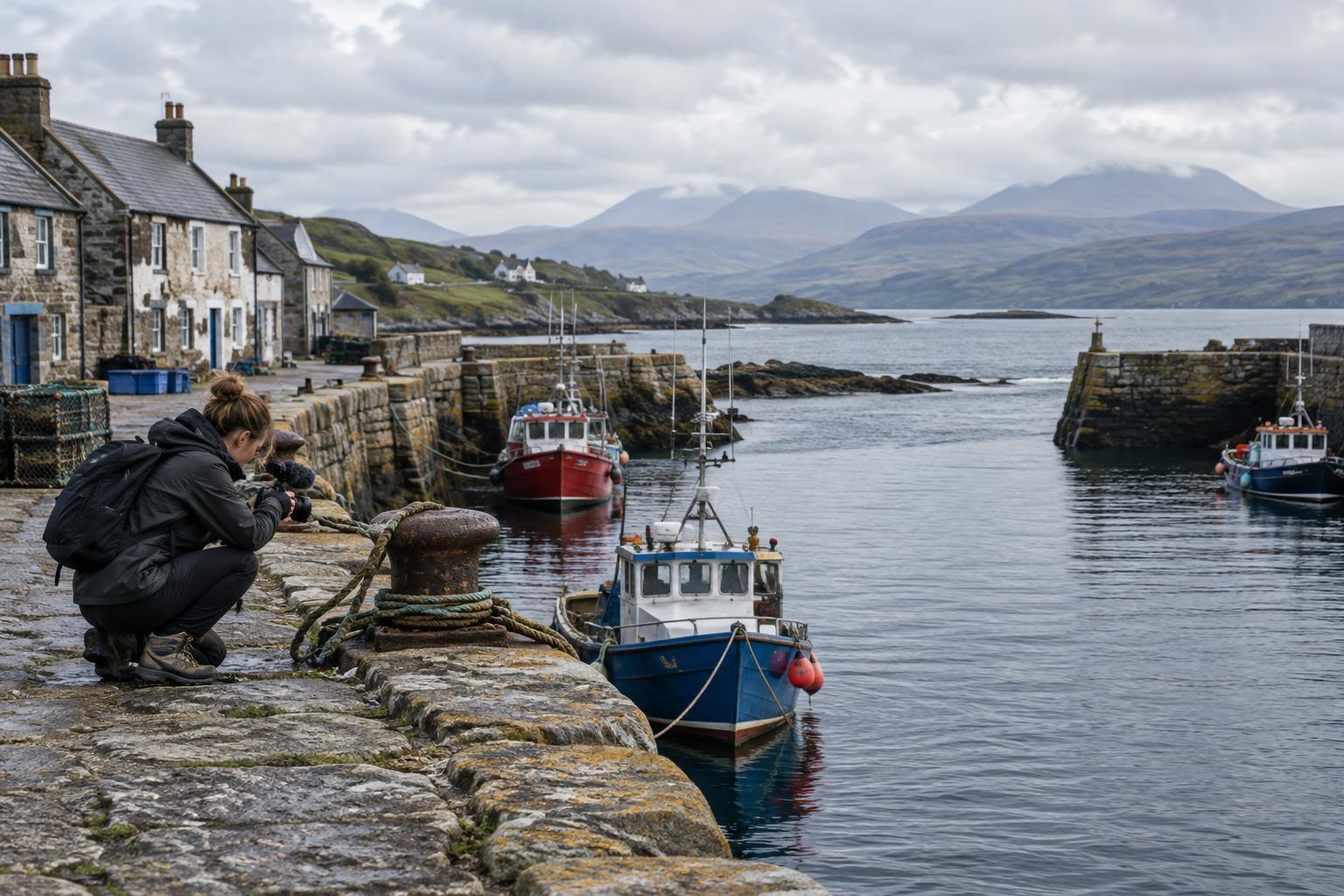
A film about a harbour, for example, might explore how work and movement shaped the surrounding community. That does not mean every Scottish harbour followed the same path. Keep a working note of what the available material establishes about this place and what it suggests only as a possibility. That distinction helps determine when the film can stay close to the ground and when it needs a wider view.
Give viewers a reason to change scale
A move from a single street to a national development should answer a question raised by the local story. Perhaps a change visible in a building prompts the viewer to ask what made its former use possible, or why that use ended. The next sequence can then introduce the wider conditions relevant to that question. Without this bridge, broad context may feel like a detour or, worse, an explanation the evidence does not justify.
Use plain transitions that identify the relationship you are making. Phrases such as “At the same time, elsewhere…” and “Here, that wider change took a different form” do different jobs. The first opens a comparison; the second warns against assuming an identical experience. In the script and edit, check that the material on either side of a transition supports the connection the narration makes.
Make the visual shift legible
Images can help viewers understand when the film is looking at one site and when it is discussing a broader pattern. Returning to a recognisable feature can anchor the local story. A restrained change in framing, an identified comparison site or a clearly labelled graphic can signal a wider perspective. These choices need not be elaborate, but they should be consistent enough that the audience can follow the movement.
Be careful with illustrative footage. A close-up of hands at work may communicate the nature of a task, but unless it documents the people and period under discussion, it cannot establish what happened at the featured site. Likewise, present-day images show what a place looks like now; they do not reveal an earlier condition by themselves. If an image is there to evoke an activity rather than document it, make that role clear through its context.
Keep people and places from becoming stand-ins
A compelling individual story can give a large historical process human scale. Its value lies partly in its particularity. One person’s account, or the history of one family, should not silently become the experience of a whole town or region. Let viewers know whose perspective they are hearing and what the film can reasonably infer from it. Where experiences differ, a carefully chosen contrast may tell the story more honestly than a single representative voice.
The same care applies to places. If the film visits another community, explain why it belongs in the story: is it a comparison, a connection or an exception? Showing a second location is not automatically proof of a national pattern. Each location should contribute a distinct piece of understanding rather than merely making the film appear geographically comprehensive.
Test the scale of the finished claim
During the edit, watch the film once with only one question in mind: how large a claim does each sequence appear to make? Viewers read meaning from the order of images as well as from words. A local example followed immediately by a sweeping statement may imply that the example proves the statement, even if no sentence says so. Adjust the transition, add necessary context or narrow the wording until the claim matches the evidence presented.
An ending does not have to resolve the entire history introduced along the way. It can return to the original place with a more precise understanding of it: what is known, what remains uncertain and how its story connects to changes beyond it. That gives the film a sense of completion without asking one street, harbour or building to speak for every Scottish experience.