Choose a short stretch, not an entire canal
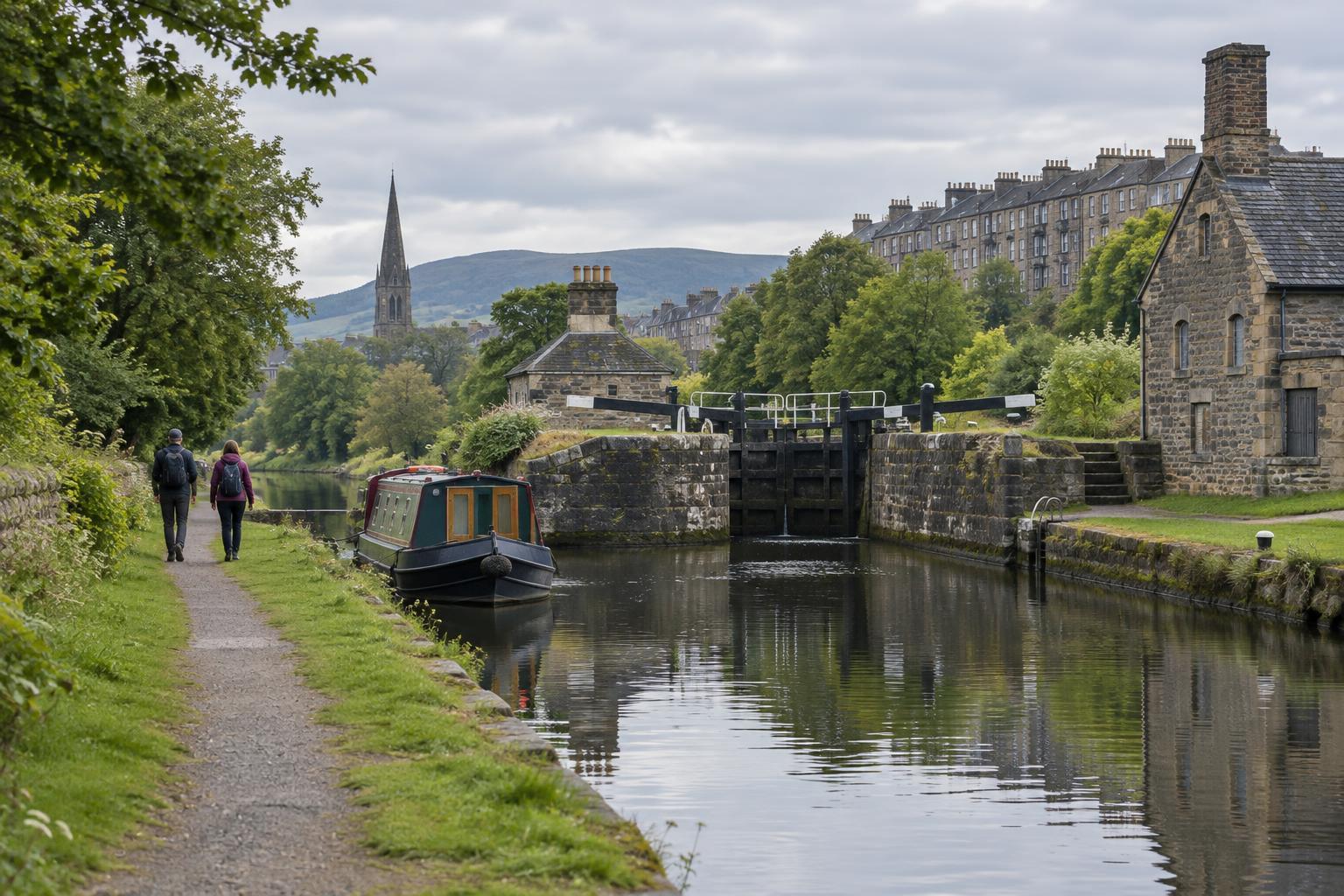
Scotland’s canals invite long journeys, but a short walk can offer a richer introduction to their history. The Forth and Clyde Canal and the Union Canal pass through varied surroundings, from built-up neighbourhoods to quieter stretches. Rather than trying to cover as much ground as possible, choose a section with a clear start, a few features to investigate and a convenient way back. A basin, lock or bridge can give the walk a useful focus.
Begin with practical questions. How will you reach the starting point? Is the return route straightforward if you decide to stop early? Towpath surfaces, gradients and access points can vary, so check current route information before leaving, especially if steps or uneven ground would be a barrier. Allow time to pause away from the path rather than treating every kilometre as a target. A modest route leaves room to notice what is beside the water as well as what is on it.
Read the waterway as a working landscape
A canal is not simply a scenic strip of water. Look at how bridges connect streets, where paths meet the towpath and how locks manage changes in level. These features can prompt questions about the effort involved in moving people and goods. They also reveal that a waterway depends on land around it: places to load, maintain, cross and reach the canal all matter.
Notice signs of change without assuming you can identify a building’s former use by appearance alone. A converted structure, a newer crossing or a gap in the streetscape may suggest a question worth pursuing, not prove a story. Interpretation boards and local museums can help, but read their accounts alongside what you can observe. If a detail is unclear, record it as an uncertainty. That habit makes a heritage walk more rewarding than a quick search for picturesque remnants.
The present-day canal deserves attention too. Boats, walkers, cyclists, nearby homes and businesses are part of the landscape you are visiting. Seeing a waterway only as a relic can obscure its continuing role as a shared place. Make space in your account of the walk for what people are doing there now, without treating them as historical scenery.
Build a walk around questions, not assumptions
Before setting out, choose two or three questions to guide your observations. Where does the canal seem closely connected to the surrounding streets, and where does it feel separate? Which features help people cross it? Where can you see evidence of maintenance or adaptation? These questions work whether you are travelling with a camera, a notebook or neither.
If you take photographs, try making a small sequence rather than collecting isolated views. A wide shot can show the canal’s relationship to a neighbourhood; a second image can show a crossing or lock; a third can capture a detail that raises a question. Write down where you stood and what you could actually see. Later, you can distinguish those observations from anything you learn through further reading. That separation is especially useful if you plan to share the walk as a visual story.
Be cautious with grand explanations based on a single stop. Canal histories include engineering, labour, transport and later changes in use, but one stretch will not illustrate every part of that story equally well. Let the place set the scale of your account. An honest description of one bridge and its surroundings can be more engaging than a sweeping claim the view cannot support.
Leave room for a comfortable, respectful visit
Treat the towpath as shared space. Keep enough room for others to pass, take particular care near narrow sections and avoid stepping close to the water’s edge for a photograph. If you stop to sketch or read an information panel, move aside where possible. Conditions can change with weather and maintenance, so bring suitable footwear and be ready to adjust the route.
A good canal outing can end well before you run out of path. Choose a place to leave the waterway, then take a moment to look back at how it fits into the wider area. What did the canal help you notice about the streets, crossings or open space nearby? That final observation can turn a pleasant walk into a more thoughtful encounter with Scottish heritage—and give you a useful question for the next one.