Mistaking an empty place for a single event
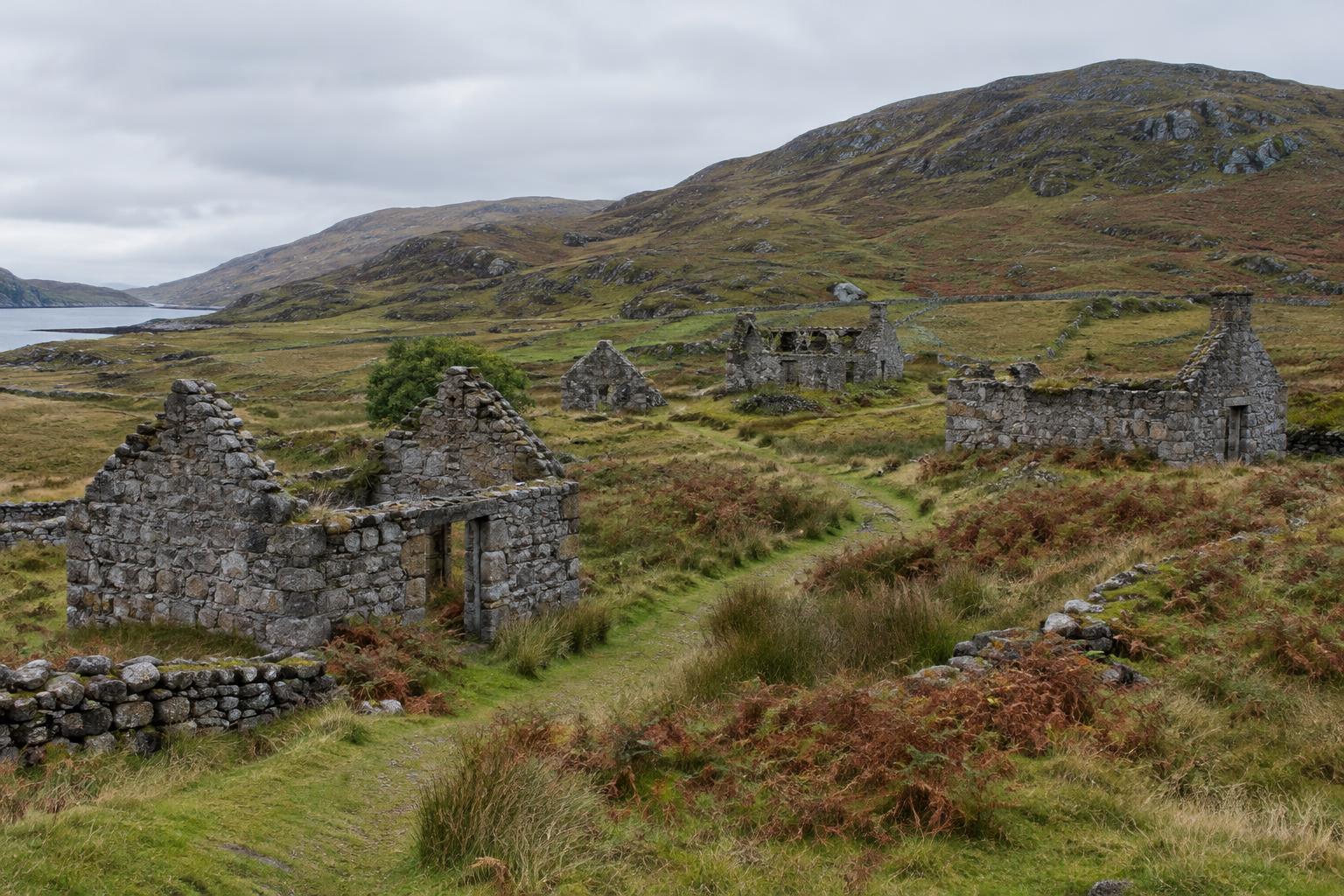
A roofless row of houses can invite an immediate explanation: everyone left at once, perhaps because of a clearance. Forced displacement is an essential part of Scottish history, but it is not the explanation for every deserted settlement. A place may have changed gradually as households moved, buildings fell out of use, or farming practices shifted. Different houses in the same settlement may even have been occupied at different times.
Begin by separating what you can see from what you infer. A standing gable, a collapsed roof and a grassed-over foundation tell you about a building’s present condition; they do not, on their own, establish when or why its occupants left. If records or local accounts point to a particular cause, say what they support and where uncertainty remains. “Abandoned” describes the site today, not necessarily a single moment in its past.
Reading every ruin as a home
A settlement was more than its dwellings. Low walls may mark byres, sheds, yards, gardens or later livestock enclosures. Nearby features could include field boundaries, cultivation remains, paths and water-management works. Their relationships can be more informative than any one ruin: an entrance facing a yard or a track leading between buildings may suggest how people and animals moved through the place.
It is easy to mistake a later structure for part of the original settlement. Stone might have been reused, walls repaired, and fields reorganised after houses ceased to be occupied. A simple sketch or set of photographs, noting what sits beside or cuts across what, helps preserve these distinctions. Avoid assigning a building a precise function from its shape alone; treat that reading as a possibility to check against other evidence.
Treating maps and names as complete answers
Historic maps are valuable, but they are snapshots made for particular purposes. A map may omit small buildings, simplify a track or use a place-name that covers a wider area than the visible ruins. Comparing maps from different periods can reveal changes, provided you allow for differences in scale and detail. The absence of a structure on one map is a clue, not proof that it had not yet been built or was already gone.
Place-names also deserve careful handling. Spelling can vary, especially where Gaelic names have been recorded in English-language documents. A name may preserve a feature of the landscape or an older association, but its apparent meaning should not be used as a shortcut to a settlement’s entire history. Match names to locations cautiously, and keep alternative spellings in your notes so that useful connections are not missed.
Letting the camera decide the story
Film and photography can make an empty settlement appear more isolated and timeless than it is. A tight shot of a doorway may exclude a modern road, an occupied farm or evidence of continuing land use. Weather and music can strengthen a mood without adding historical evidence. These choices are not wrong, but they become misleading when atmosphere is allowed to stand in for explanation.
If you are documenting a site, pair evocative images with wider views that show its setting and connections to the surrounding landscape. Record the direction you are looking and distinguish visible features from interpretations in captions or narration. Where an old photograph or recollection adds context, identify it for what it is rather than implying that it shows the same moment or viewpoint as your present-day footage.
Overlooking living connections and practical care
Deserted does not mean forgotten. People may still know the settlement through family history, place-names, grazing, walking routes or local memory. Such knowledge can raise questions that are absent from a map or visible in a ruin, though memories, like written records, should be considered in context. Ask rather than assume, and avoid presenting one person’s account as the voice of an entire community.
Care matters on the ground, too. Ruined walls can be unstable, and a quiet site may sit within working land or near occupied homes. Follow access guidance, respect privacy, close gates as you find them and leave stones and objects where they are. The most useful interpretation often comes from a modest conclusion: identify what is visible, explain what evidence might clarify it, and make room for parts of the story that the landscape alone cannot tell.