Start with the village, not a checklist
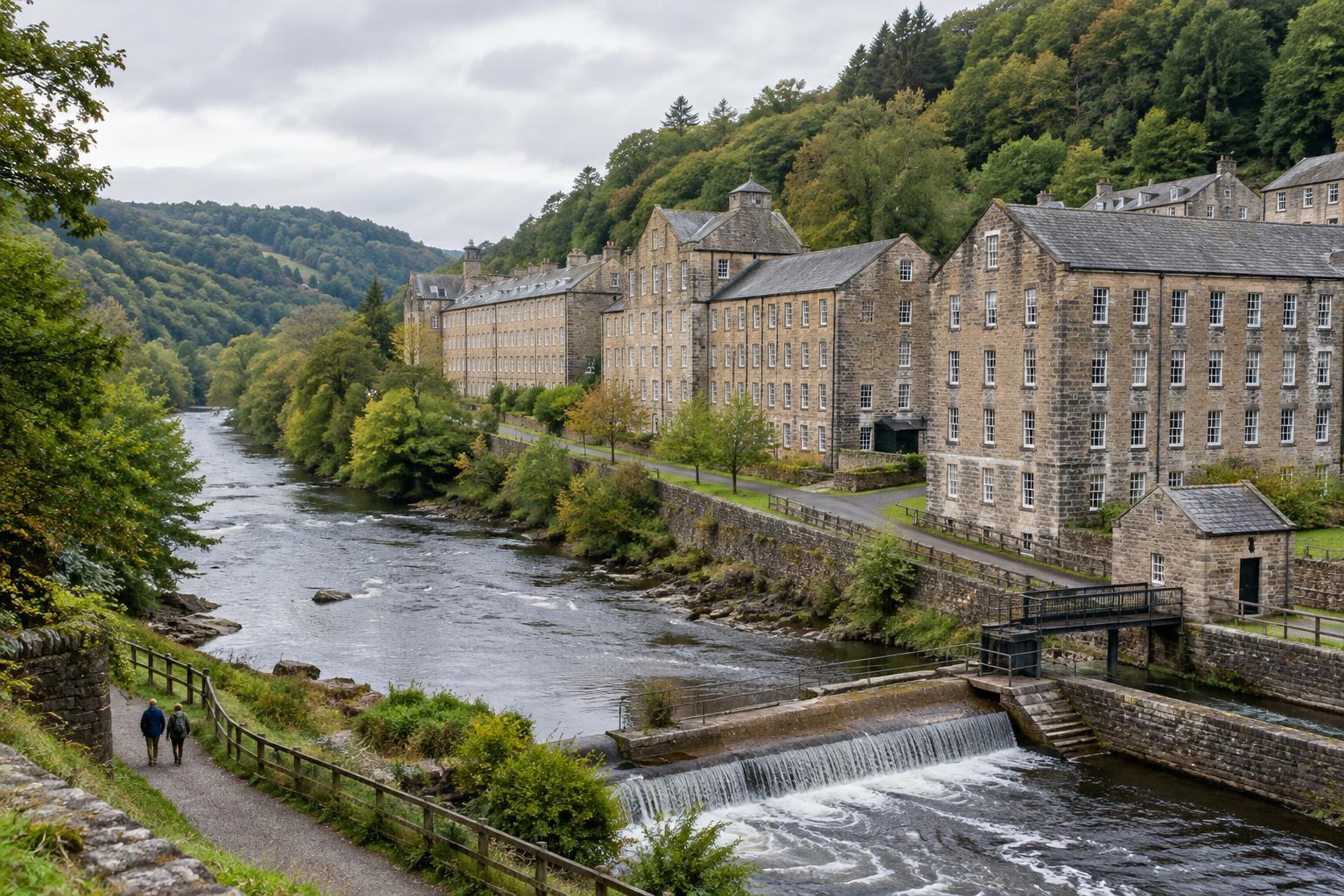
New Lanark sits beside the River Clyde, below the town of Lanark. Its position matters: the river helped power the cotton mills, while the steep valley shaped how the village was built and approached. On arrival, take a few minutes to look across the whole settlement before entering a building. Notice the relationship between the large mill blocks, the workers’ housing and the paths that connect them. This first view gives you a framework for everything you see later.
A day trip works best if you leave room for both the visitor attractions and an unhurried walk. Check opening arrangements, transport connections and accessibility information before setting out, as these can change. If you are arriving without a car, allow time for the journey between Lanark and the village. Comfortable shoes are useful: the site and its surroundings involve slopes, and the riverside paths may be uneven or wet.
Understand why the mills were built here
New Lanark developed as a cotton-spinning village in the late eighteenth century. David Dale established the mills, drawing on the Clyde’s water power and a planned settlement for the workforce. As you move through the site, try to imagine the practical demands behind its layout. Raw material, machinery, workers and finished yarn all needed space and routes through a busy operation. The surviving buildings make that organisation easier to grasp than a description alone can.
The dramatic setting can make industry look unexpectedly peaceful. Pause near the mill buildings and listen to the river, then consider how different the soundscape would have been when machinery was running and people were at work. The water was not simply scenery; it was part of the village’s productive system. Looking at the landscape this way turns a scenic stop into a question about energy, labour and the choices that shaped industrial development.
Look beyond the familiar story of Robert Owen
Robert Owen, who later managed the mills, is central to New Lanark’s interpretation. His interest in education and living conditions made the village an influential example in debates about industrial society. Displays about schools, housing and community life can help you see why visitors travelled to learn from it. Yet the story is more useful when treated as a set of questions than as a simple tale of progress.
Ask who worked in the mills, what a working day required and how much choice workers had within a community organised around one employer. Improved facilities did not remove the demands of factory labour or the unequal power between owners and employees. Pay attention, too, to the cotton itself: New Lanark belonged to wider networks of production and trade extending far beyond Scotland. A thoughtful visit holds the village’s reforming ambitions alongside the people and systems on which the mills depended.
Use displays and images as evidence, not a window into the past
Visitor centres often combine historic buildings, objects, images and modern interpretation. Give yourself time to read labels rather than relying on a quick impression. When you encounter a photograph, film, model or recreated room, ask when it was made and what it can actually show. A reconstruction may clarify how a space was used, but it is not the same thing as an untouched room from the mill’s working years.
This habit makes the trip especially rewarding for anyone interested in visual history. Compare what an image emphasises with what you can observe outside its frame: the scale of a building, the distance between home and workplace, or the river just beyond the walls. If a display leaves you wondering about a worker’s experience, keep the question open. Not every everyday detail survives in the record, and an honest gap can be more revealing than an imagined answer.
Finish by following the Clyde
If conditions and your energy allow, end the visit with a walk along a suitable section of the riverside paths. Views back towards the village can help you reconnect its architecture with the water that made the location attractive to mill builders. Choose a route that fits your mobility and available daylight, and check local path information before going further into the valley. You do not need a long hike to appreciate the setting.
Before leaving, look back at the mills from a little distance. The buildings tell a story of industrial ambition, but also of homes, schooling and daily routines gathered around work. New Lanark rewards visitors who move between those scales: from the sweep of the Clyde valley to the details of an interpreted room. That approach makes the day trip less about ticking off a landmark and more about understanding how Scotland’s industrial past occupied a real, lived-in place.